Independent, Fee-Only Financial Advisor

Independent, Fee-Only Financial Advisor

Wednesday, July 03, 2013

Evolving 401(k) Slates

I see a lot of 401(k) fund slates from clients of varying quality. Tragically, many that I see are made up of high fee, erratically performing, actively managed mutual funds. On top of that, they may not even have very good diversification!

Fortunately, things are changing in the 401(k) world.

  • Passive index funds are more prevalent now. While not all index funds are equal, they typically have lower expense ratios than active funds, and have negligible risk of style drift or benchmark divergence.
  • Target date funds are making an appearance. These make an easy one stop shop for a worker, especially when their 401(k) balance is small. Even if the rest of the slate is poor, a single target date fund will generally have an appropriate, diverse mix for your age.
  • ETFs! Wisdomtree has been working on getting their ETFs into 401(k) plans already and word is that Schwab has 'cracked the code' to get ETFs to fit and work in a 401(k) plan. While I have yet to see these in practice, they should even the playing field as far as expense ratios go, since ETFs only have one share class with one expense ratio. Additionally, ETFs offer transparency which may be of some use to the investor, but will serve as deeper scrutiny for managers.
Simpler, better diversified slates are becoming the norm. Cutting costs is very beneficial to these long term investors. Overall, the trends are beneficial to 401(k) savers.

Wednesday, March 13, 2013

Protecting Against Fraudulent Annuity Sales

Insurance products have very high sales commissions, which is why we at New Perspectives try to discourage clients from buying them. Generally, most benefits of an annuity are replicable in a carefully managed investment account for much lower fees, therefore more potential for return.

Because the sales commissions are so high, the sales people push these products hard. Many people know of a friend or family member who was pushed into an expensive contract that they didn't totally understand. The hard sell tactics toe a fine line between salesmanship and fraud. Just like during the mortgage and housing boom when incentives to make mortgages led to hard sells, deception and sometimes outright fraud, insurance sales people can push into murky territory easily.

According to this article, Florida is doing something about that. High suitability requirements are being extended to people of all ages (we don't think annuities are suitable for just about anybody!). The laws also extend the amount of time people have to decide about their purchase and restrict the surrender periods.

Surrender periods are one of the worst features of annuities. Annuities tie up your money, but surrender charges make it expensive to untie your money. Typically these are in a schedule of declining fees over 7-12 years. It is possible to get annuities from Vanguard of Jefferson National with excellent investment options and no surrender charges - so keep that in mind when someone says that theirs is the best. Talk with a fee only, fiduciary advisor for advice that is in your best interest.

Tuesday, March 05, 2013

Housing Recovery

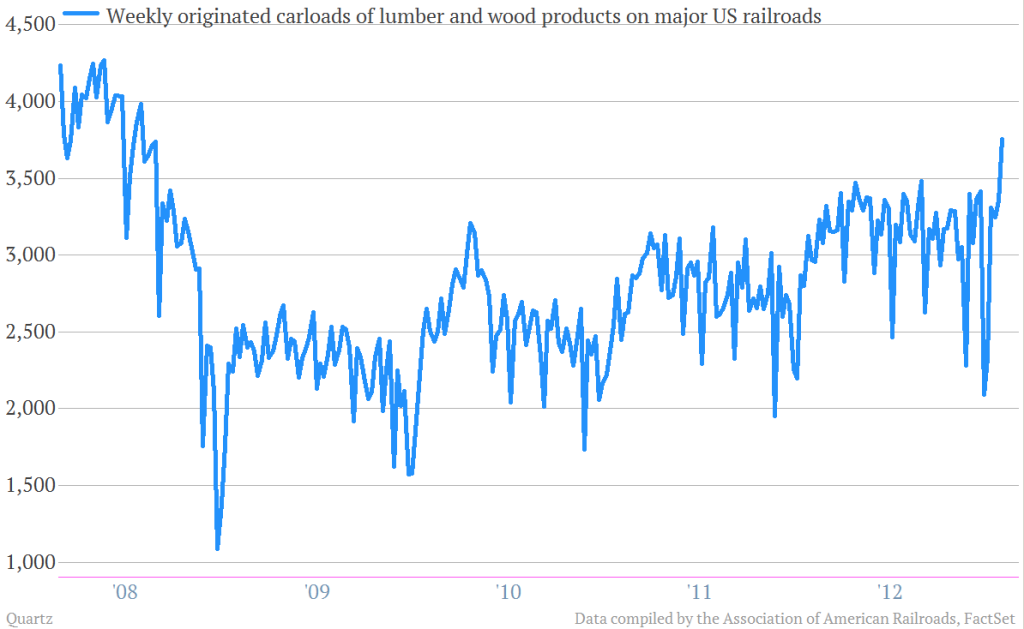
One interesting indicator behind housing is Lumber. Lumber is, of course, used to build houses in America, and is a key ingredient in many home improvement projects (like the shelves I just built in my closet this weekend).

The price of lumber is dictated by supply and demand, of course, and that has been a rising price lately. For much of the past 5 years, lumber prices have been between $150 and $250, with two peaks above $300. The end of 2012 and the first two months of this year have seen those prices hit close to $400.


Looking at charts in this article, lumber shipments appear to follow a seasonal pattern reflected in housing prices. This time looks to be different. The seasonal decline in lumber shipments has not been as large as usual. Combining rising lumber prices with greater shipments means much more money is being spent on lumber now than at the peak. When money flows representing desires and expectations in the economy, more money going to lumber means more confidence in housing - a huge driver of the American economy.


Friday, February 15, 2013

Trailing Returns

When judging mutual fund performance, people often look at trailing returns. Trailing returns ask the question, "how has this fund done in the past year, past three or five or ten years?" Returns are simply the price change over the given period, expressed as a percentage of the starting price.

The starting date matters a lot in measuring returns. As price of funds or stocks changes every day, moving the starting date a few days around can make a huge difference. If a stock is at $110 today, measuring from a $100 starting point gives you a 10% gain, but if it traded at $95 around that time gives you a nearly 16% return - what a difference a day makes!

The implications for funds are more interesting still. Five years ago on Valentines Day S&P 500 closed at 1348.86, one year later it closed at 789.17. Yesterday the closing price was 1521.38, this made a 2.4% annual return for the past 5 years, but a 17.8% annual return for the past 4. Clearly, the day you measure from matters.

These returns are so dramatically different because of the massive drop in the market from the end of 2007 to the beginning of 2009. When you measure from a market peak - most returns will look lackluster, but measuring from a trough will make them look exceptional. Keep starting dates in mind when looking at trailing returns, and make sure to compare them to something you have a better grip on.

Thursday, February 14, 2013

What to do with that raise!

Everyone is buzzing about the potential for the minimum wage to be raised to $9 from $7.25/hr. This is exciting news for anyone making less than, or maybe just near $9 as they would see their wages increase immediately. What is the best use of all that newfound pay?

It is always important to have money saved for a rainy day (or a disaster, or recession really). Regardless of your wage level, a raise is an opportunity to save more money that you weren't even spending before. A cash savings account is important for short term needs.

A raise shrinks your debt when compared to your income. This personal inflation is good for you if you have a balance left to pay on a credit card or other revolving debt. As long as your spending doesn't increase proportionally, the extra income puts you in a much better position to save. While mortgage and other fixed rates are low right now, credit card balances can always do with lowering.

Reducing debt, increasing savings and spending should be a good thing for the economy. While all of the extra money may create some inflation, it would do more to bolster the positive economic trends we have already.